TL;DR:
- Pre-production is crucial for establishing a clear plan, budget, and creative decisions, reducing costly on-set problems.
- Thorough pre-prodcution planning enhances efficiency, budget adherence, and creative flexibility during filming.
- Investing in detailed previsualization and organized planning early on saves time, money, and preserves creative vision.
Pre-production is one of the most misunderstood phases in filmmaking. Many producers and directors treat it as a formality, a stack of paperwork to push through before the real work begins. That framing is costly. Pre-production is where your film is won or lost, where budget discipline is established, creative decisions are locked in, and the entire shoot is mapped before a single camera rolls. Get it right, and everything downstream moves faster, smarter, and with fewer surprises. Get it wrong, and you spend your shoot days solving problems that should have been solved weeks earlier.
Table of Contents
- Defining pre-production in film
- Key components and stages of pre-production
- Common challenges and solutions in pre-production
- How pre-production enhances project efficiency
- A seasoned producer’s take: The hidden ROI of pre-production
- Bring efficiency to your next production with Push Pull
- Frequently asked questions
Key Takeaways
| Point | Details |
|---|---|
| Core phase | Pre-production sets the creative and operational foundation for every film project. |
| Stepwise planning | Breaking down tasks by stage prevents surprises and enables smoother shoots. |
| Previsualization power | Early scene visualization with previs saves time and money, especially for complex projects. |
| Avoiding pitfalls | Thorough pre-production helps dodge costly mistakes and bottlenecks. |
| Boosted efficiency | Well-planned pre-production enhances creativity and project delivery speed. |
Defining pre-production in film
To understand its importance, let’s clarify what pre-production in film actually covers. Pre-production is the planning and organizational phase that happens after a project is greenlit but before principal photography begins. It’s not one task. It’s a sequence of interconnected decisions, each one building on the last.
Here’s what pre-production actually includes:
- Concept development and script finalization: Locking the story, tone, and structure before any other planning can begin.
- Budgeting: Translating the script into a financial plan, line by line.
- Scheduling: Building a shooting schedule that accounts for locations, cast availability, and crew logistics.
- Casting: Identifying, auditioning, and contracting the right talent.
- Crew hiring: Assembling department heads and key crew members.
- Location scouting and permits: Finding the right environments and securing legal access.
- Previsualization (previs): Creating visual representations of complex scenes before shooting them.
Previsualization deserves special attention. Previs originated in the silent era and evolved dramatically with digital tools, becoming a standard practice for effects-heavy and action-driven productions. Today, it’s used to plan camera angles, blocking, and visual effects sequences with precision.
The deliverables at the end of a strong pre-production phase include a locked shooting script, a detailed shooting schedule, a finalized budget, signed location agreements, and a storyboard or previs package. These aren’t just documents. They’re the operational blueprint for your entire production.
“Pre-production is where the film is made. The shoot is just where you photograph it.” This perspective, shared widely among experienced producers, reflects a fundamental truth about where creative and financial control actually lives.
When you invest in thorough pre-production, you’re buying insurance against the most expensive problems in film. A script change on day one of shooting can cost tens of thousands of dollars. The same change made during pre-production costs a conversation. Partnering with experienced production services early in this phase gives you access to infrastructure and expertise that makes every planning decision more grounded and executable.
Key components and stages of pre-production
With the scope defined, let’s examine each pre-production stage and its key components. The sequence matters as much as the tasks themselves, because each stage creates dependencies that affect everything that follows.
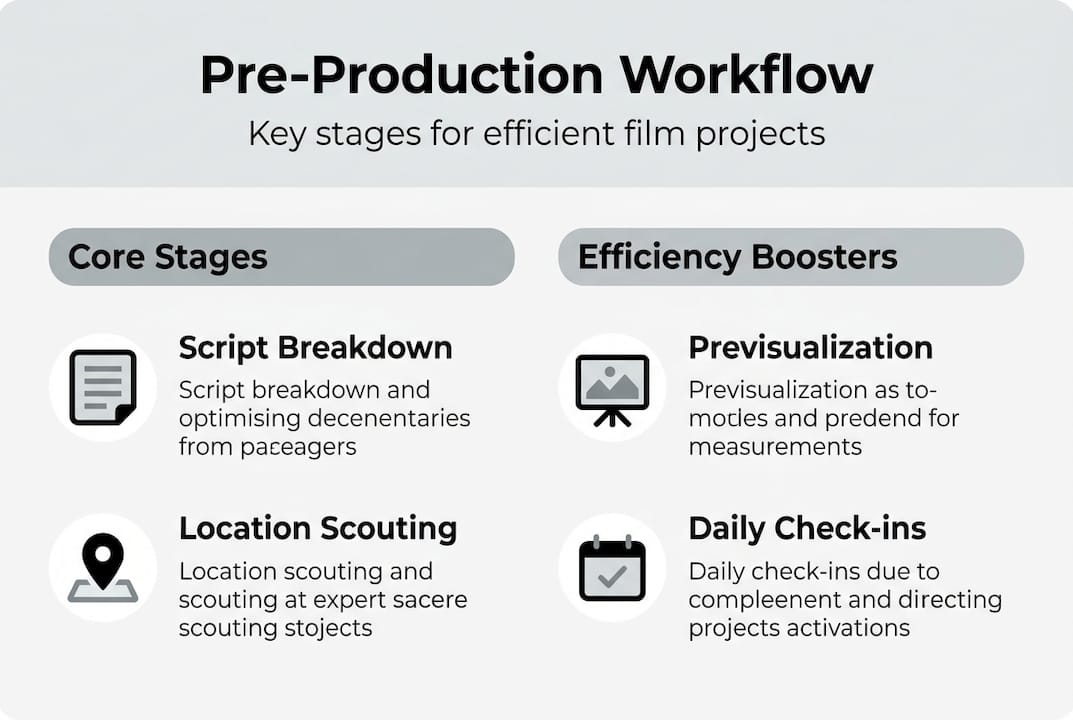
- Script breakdown: Analyzing every scene for cast, locations, props, costumes, and special requirements.
- Storyboarding and previs: Visualizing key sequences to align the director, DP, and department heads.
- Budgeting: Assigning costs to every element identified in the breakdown.
- Scheduling: Building the shooting order based on location availability, cast contracts, and budget priorities.
- Casting: Running auditions, negotiating deals, and confirming availability.
- Location scouting: Identifying and securing physical environments that match the script’s requirements.
- Final logistics: Confirming transport, accommodation, equipment rentals, and permits.
| Stage | Responsible party | Main output |
|---|---|---|
| Script breakdown | 1st AD, Line Producer | Breakdown sheets |
| Storyboarding/previs | Director, Previs Supervisor | Visual reference package |
| Budgeting | Line Producer, UPM | Approved budget |
| Scheduling | 1st AD | Shooting schedule |
| Casting | Casting Director | Signed contracts |
| Location scouting | Location Manager | Location agreements |
| Final logistics | Production Coordinator | Confirmed vendor contracts |
The dependencies here are real and consequential. Your location choices directly affect your schedule (travel time, setup time, permit windows) and your budget (fees, transport, accommodation). Locking locations before finalizing the schedule isn’t optional. It’s the only logical sequence. Exploring scouting locations early in the process, and understanding what film studio selection and backlot locations offer, gives your planning team real data to work with instead of assumptions.

Pro Tip: For VFX-intensive films, invest in detailed previs before locking the schedule. Previs is widely used for stunts, chroma key, and complex choreography, and changes made after previs is complete are significantly more expensive to accommodate. The previs phase is your cheapest opportunity to experiment.
Proper sequencing prevents rework. A production that rushes into scheduling before the script breakdown is complete will revise that schedule multiple times, each revision consuming time and eroding team confidence.
Common challenges and solutions in pre-production
Having outlined the stages, what challenges do filmmakers actually encounter, and how can they be tackled effectively?
The most common bottlenecks in pre-production include:
- Incomplete script breakdowns: Missed elements surface during production, creating unplanned costs.
- Unclear role assignments: When no one owns a task, it doesn’t get done on time.
- Underestimated time and budget needs: Optimism bias is real. Productions consistently underestimate how long pre-production takes.
- Delayed location permits: Government and private permitting timelines are often longer than expected, especially in unfamiliar regions.
- Late casting decisions: Talent availability shapes the schedule. Locking cast late forces schedule compromises.
The solutions are structural, not heroic. Adopt production management software that keeps all departments aligned on a single source of truth. Run detailed script breakdowns with all department heads in the room. Hold early alignment meetings where creative intent and logistical constraints are discussed together, not in separate silos.
The vast majority of costly production overruns trace directly back to decisions, or the absence of decisions, made during pre-production.
This isn’t a minor finding. It means that the budget you protect during pre-production is the budget you keep during the shoot. Investing in production workflow strategies that build structure into your planning phase pays dividends every single day on set.
Building contingencies into your plan is not pessimism. It’s professionalism. A 10 to 15 percent budget contingency and schedule buffer for key risk areas (weather, permits, talent) is standard practice for a reason.
Pro Tip: Schedule a short daily check-in during pre-production. Issues caught early are dramatically cheaper to resolve. A 15-minute morning sync across department heads surfaces conflicts before they become crises.
Also, changes after previsualization are costly and time-consuming, which is why the previs phase must be treated as a decision-making checkpoint, not just a visual exercise.
How pre-production enhances project efficiency
Now, how does all this upfront effort reward the actual project once cameras roll?
The answer shows up in every department, every day. Here’s a direct comparison:
| Factor | Meticulous pre-production | Rushed pre-production |
|---|---|---|
| Budget adherence | Consistent, predictable | Frequent overruns |
| Shooting days | On schedule | Delays common |
| Creative flexibility | High, decisions are pre-made | Low, reactive problem-solving |
| Crew morale | Stable, confident | Stressed, uncertain |
| Post-production handoff | Clean, organized | Chaotic, costly revisions |
The contrast is stark. Rushed pre-production doesn’t save time. It borrows time from your shoot and pays it back with interest.
“Extensive previsualization saves resources in effects-heavy or virtual productions by resolving creative and technical conflicts before they become on-set emergencies.”
This principle applies beyond VFX. Any production with complex choreography, multiple locations, or large ensemble casts benefits from the same logic. Resolve conflicts on paper first. They’re free to fix there.
Consider the Sofia Film Fest promo 2024 as a practical example. Detailed pre-production planning enabled the team to execute a visually polished piece on a tight schedule, because every shot was mapped, every location confirmed, and every logistical dependency resolved before the first shooting day. The result was a promo that looked like it had twice the budget and twice the time.
Thorough preparation doesn’t make your shoot rigid. It makes it resilient. When you’ve pre-planned 90 percent of your decisions, you have genuine bandwidth to respond to creative insights on set, to chase a better angle, to extend a performance, to adapt to unexpected light. That flexibility is only possible when the foundation is solid.
A seasoned producer’s take: The hidden ROI of pre-production
Here’s what most articles won’t tell you: the producers who resist heavy pre-production often do so because they’ve confused planning with rigidity. They’ve been in rooms where pre-production became bureaucratic theater, checklists for the sake of checklists. That’s a failure of execution, not a failure of the concept.
Real pre-production is about making decisions when they’re cheap. Every creative choice you defer to the shoot costs more money, more time, and more goodwill from your crew. The projects that invest in the invisible work, the breakdown sessions, the location scouts, the previs reviews, consistently deliver bigger on-screen results for the same budget.
The uncomfortable truth is that pre-production is where your creative vision either gets protected or eroded. A director who walks onto set with every key decision already made can spend their energy on performance and nuance. A director who arrives still solving logistics is already behind.
At Push Pull, we’ve seen this dynamic play out across productions in Bulgaria, North Macedonia, and North Greece. The teams that arrive with thorough prep get more out of every shooting day. Accessing full production support from the pre-production phase forward is the single biggest lever most productions haven’t fully pulled.
Bring efficiency to your next production with Push Pull
Effective pre-production is the differentiator between a film that struggles through its shoot and one that arrives in post with clean footage, a balanced budget, and a crew that wants to work together again.

At Push Pull, we support productions from the earliest planning stages through principal photography across Bulgaria, North Macedonia, and North Greece. Our production planning services connect you with skilled professionals who know how to build the infrastructure your project needs before day one. Explore our dedicated film studios and versatile backlots to understand what’s available for your next project. We don’t just keep things on track. We help you build a track worth running on.
Frequently asked questions
What is the main goal of pre-production in film?
The main goal is to plan every creative and logistical detail before filming begins, minimizing delays, budget overruns, and on-set confusion.
Why is previsualization important in pre-production?
Previsualization helps teams map complex scenes visually before shooting, preventing expensive mistakes. Previs originated in the silent era and is now essential for VFX and choreography-heavy sequences.
How long does film pre-production usually take?
Pre-production can range from a few weeks for short films to several months for features, depending on the project’s scale, locations, and visual complexity.
What happens if pre-production is skipped or rushed?
Rushing pre-production leads directly to missed deadlines, inflated costs, and creative compromises on set. As the data shows, changes after previsualization alone are costly and time-consuming, and that principle scales across every planning shortcut taken.


